 Español

Difference Between Essential Oil and Premix
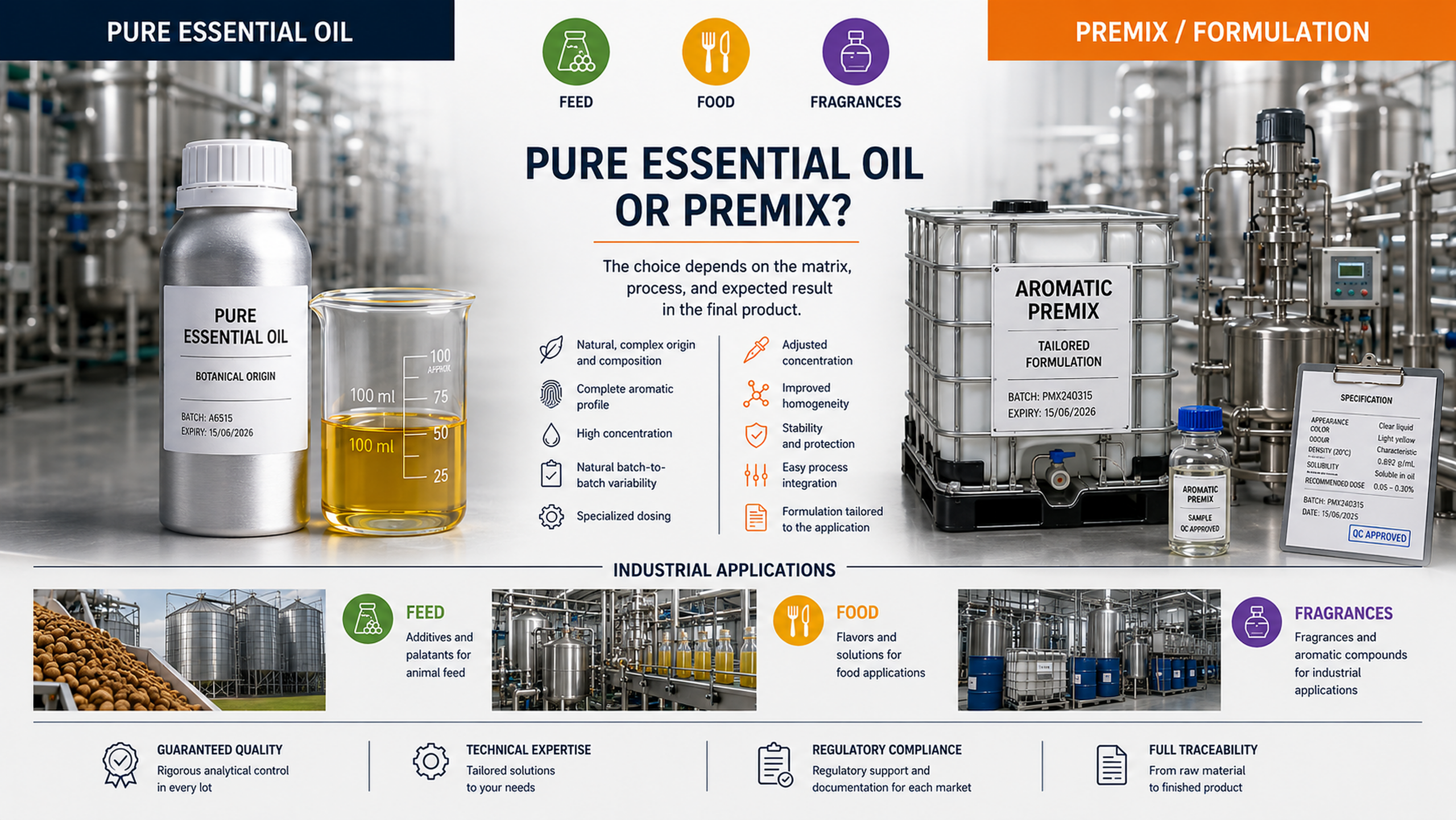
Pure essential oil or premix: the choice does not depend on which option is better in absolute terms, but on what each product needs. In industrial applications, it is important to assess the matrix, dose, stability, manufacturing process, ease of incorporation and the documentation required in each sector.
For this reason, the decision requires a technical and application-based assessment. A pure essential oil may be the right option when the aim is to preserve the botanical identity of a raw material. By contrast, a premix or aromatic formulation may be more suitable when the project requires concentration adjustment, easier dosing, improved incorporation into the process or the reproduction of a defined aromatic profile.
What is a pure essential oil?
How pure essential oils are obtained
A pure essential oil is a volatile aromatic raw material obtained from an aromatic plant, usually by steam distillation, hydrodistillation or mechanical expression in the case of some citrus fruits.
It is not a fatty oil like a vegetable oil. Instead, it is a concentrated mixture of natural aromatic compounds responsible for the characteristic odour of the plant.
When we refer to a pure essential oil, we mean an oil that has not been subsequently blended with carriers, solvents, vegetable oils or other added ingredients. Its composition comes from the botanical raw material and may include different families of molecules, such as terpenes, alcohols, aldehydes, ketones, esters or phenols, depending on the plant species and chemotype.
Natural variability between batches
However, the fact that an essential oil is pure does not mean that all its batches have exactly the same composition. Nor does it mean that it is always the most suitable option for every application.
Its profile may vary naturally due to factors such as origin, harvest, climate, extraction method or storage conditions. This variability does not necessarily indicate a lack of quality. In fact, it is part of the nature of essential oils.
Nevertheless, when an essential oil is intended for an industrial application, its identity, composition and consistency must be controlled through appropriate specifications and analytical methods [1] [2].
Purity and quality are not the same
It is also important to distinguish between purity and quality. An oil may contain no added carriers and still have a composition that is not suitable for a specific application.
Therefore, quality should be assessed according to authenticity, specifications, state of preservation and suitability for the intended use.
What is a premix or aromatic formulation?
A previously developed aromatic blend
A premix or aromatic formulation is a previously developed blend made from aromatic ingredients. It may consist of several essential oils, essential oils combined with aroma chemicals, or a more complex composition designed to achieve a specific aromatic profile.
Unlike a pure essential oil, which comes from a single botanical raw material, a premix makes it possible to combine different raw materials to build, adjust or reproduce a defined aromatic profile.
Different objectives depending on the formulation
As a result, a premix may be used when greater consistency, a specific intensity, a defined aromatic identity or a solution adapted to the needs of a product is required.
However, the purpose of a premix is not always the same. In some cases, it is formulated to combine several essential oils. In others, it may be used to adjust aromatic intensity, improve batch-to-batch consistency, facilitate dosing, adapt the composition to a specific matrix or obtain a more stable and reproducible sensory result.
A general concept that changes by sector
Therefore, a premix should not be understood simply as a diluted essential oil or as a blend designed only to facilitate incorporation into the final product. It is a previously developed aromatic formulation whose composition and function depend on the technical, sensory and commercial objective of the development.
In addition, the specific name of these formulations may change according to the sector of application. In animal feed, human food or fragrances, terminology and applicable documentation are not exactly the same. This difference is analysed in more detail in the second part of the article, dedicated to industrial applications in Feed, Food and Fragrance.
Difference between essential oil and premix: main criteria
Technical criteria for comparison
The difference between a pure essential oil and a premix is not limited to the fact that one comes directly from a plant and the other is a formulated blend. Therefore, the comparison should be made from a technical perspective: composition, aromatic identity, variability, concentration, ease of dosing, behaviour in the matrix, stability, documentation and real cost in use.
In an industrial application, the most suitable option is not always the most concentrated or the most natural-looking one. What matters is how each solution behaves during the manufacturing process and what result it provides in the final product.
Comparison table
| Criterion | Pure essential oil | Premix or aromatic formulation |
|---|---|---|
| Origin | Obtained from a specific botanical raw material | Developed from a combination of aromatic ingredients |
| Composition | Maintains the full natural profile of the essential oil | May combine several essential oils, aroma chemicals or other ingredients |
| Aromatic identity | Linked to the plant, chemotype, origin and batch | Can be built or adjusted to reach a defined aromatic profile |
| Variability | May show natural differences between batches | Can be formulated to improve profile consistency |
| Concentration | Usually contains a high concentration of volatile compounds | Can be adjusted according to the intended intensity and use |
| Dosing | May require greater precision when used in small quantities | Can facilitate dose control depending on the formulation |
| Behaviour in the matrix | Depends on the compatibility of the oil with the final product | Can be adapted to specific technical or sensory needs |
| Customisation | Limited to the profile of the selected oil | Allows different raw materials to be combined, adjusted and adapted |
| Documentation | Focused on the identity and characteristics of one raw material | Must describe the formulation, composition and conditions of use |
| Real cost | Should be assessed according to dose, performance and stability | Should be analysed by cost in use, not only by price per kilogram |
The comparison should always be made on the real application: matrix, dose, stability, homogeneity, industrial process and final result.
When to choose a pure essential oil
Botanical identity and natural complexity
A pure essential oil may be the most suitable option when the botanical identity and natural complexity of the raw material are an essential part of the product. This may be the case when the aim is to preserve the characteristic profile of a specific aromatic plant or when the product positioning is based on the botanical origin of the ingredient.
Direct incorporation into the matrix
In addition, it may be a good choice when the matrix allows direct incorporation and the manufacturer has precise dosing systems. In these cases, the essential oil provides the full profile of the raw material, provided that its natural variations remain within the established specifications.
Validation before industrial use
However, the selection should not be based only on whether the oil is pure or natural. Before incorporating it into an industrial product, it is advisable to verify its composition, stability, compatibility with the matrix, behaviour during the process and suitability for the intended use.
In addition, some volatile components may be affected by factors such as temperature, oxygen, light, storage time or interaction with other ingredients. For this reason, even when working with a pure essential oil, its behaviour must be validated under real conditions of use [2].
When to choose a premix
Building a defined aromatic profile
A premix may be more suitable when a specific aromatic profile needs to be built from several raw materials. It may also be useful when the aim is to adjust intensity, improve batch-to-batch consistency, facilitate dosing or adapt the aromatic solution to the characteristics of the final product.
Greater control over the aromatic result
In practice, a previously developed blend allows greater control over the aromatic result. Instead of relying only on the profile of a specific essential oil, a premix makes it possible to combine ingredients to achieve an aromatic direction that is more defined, more stable or more aligned with the objective of the product.
Testing under representative conditions
However, a premix should not automatically be considered better, more stable or more homogeneous. Its behaviour must be tested under representative conditions of use, taking into account the matrix, process, dose and expected sensory result.
Therefore, choosing a premix should respond to a clear objective: reproducing a profile, adjusting intensity, combining raw materials, improving consistency or adapting an aromatic solution to a specific formulation need.
How to compare both options in an industrial application
Testing under equivalent conditions
To compare a pure essential oil and a premix, both should be tested in the same matrix and under equivalent conditions. The comparison should consider the effective dose of aromatic components, ease of incorporation and homogeneity.
It should also assess stability during processing, evolution throughout shelf life and the final sensory result.
Technical verification
When necessary, chemical markers or instrumental techniques may also be used to verify composition and consistency. However, comparing only price, initial concentration or the olfactive intensity of the product before application does not determine how it will behave in an industrial process.
In an industrial application, the best option is not always the purest, the most concentrated or the most complex one. It is the option that responds best to the matrix, the process and the expected result.
Pure essential oil or premix: technical conclusion
The right option depends on the objective
As a result, the best alternative is the one that responds to the real objectives of the product. A pure essential oil may be preferable when botanical identity, natural complexity and direct incorporation are required.
Pure and formulated are not opposites
By contrast, a premix, flavouring, blend or formulation may be more suitable when the aim is to control dose, facilitate distribution, maintain a defined profile or adapt the aromatic solution to an industrial process.
In some developments, the optimal answer may also consist of using selected essential oils as the basis of a formulation designed specifically for the product.
Therefore, the choice should be made according to the matrix, process, regulatory framework, documentation and expected result. There is no universally superior solution.
Want to see how the choice changes by sector?
The comparison between a pure essential oil and a premix does not end with the technical definition. In practice, the decision changes according to the sector of application, the product matrix and the manufacturing conditions.
That is why we have prepared a second part focused on industrial applications in Feed, Food and Fragrance.
Read the second part: pure essential oil or premix by sector.
Frequently asked questions about pure essential oil or premix
Does a pure essential oil always have higher quality?
No. Purity indicates that no other components have been added. However, quality also depends on authenticity, composition, preservation, specifications and suitability for the application.
Is a premix simply a diluted essential oil?
Not necessarily. A premix may be a formulation developed with several essential oils, aroma chemicals or other aromatic ingredients selected for a specific purpose.
Can a premix be made only with natural ingredients?
Yes, provided that all the ingredients used meet that criterion. Even so, the composition and documentation must be verified.
How can you determine which option works better?
Through tests carried out in the final matrix and under conditions close to the industrial process. This makes it possible to compare dose, distribution, stability and the result obtained.
References and consulted sources
-
Sadgrove, N. J., Padilla-González, G. F. and Phumthum, M. (2022).
Fundamental Chemistry of Essential Oils and Volatile Organic Compounds, Methods of Analysis and Authentication.
Plants, 11(6), 789. DOI: 10.3390/plants11060789.
View source. -
Karami, A., Tashani, F., Tahmasebi, A. and Maggi, F. (2021).
Chemical Variability in the Composition of Zhumeria majdae Essential Oil According to Storage Time and Temperature.
Horticulturae, 7(11), 463. DOI: 10.3390/horticulturae7110463.
View source. -
European Parliament and Council of the European Union. (2003).
Regulation (EC) No 1831/2003 of 22 September 2003 on additives for use in animal nutrition.
Official Journal of the European Union, L 268, 29-43.
View regulation. -
EFSA FEEDAP Panel. (2017).
Guidance on the identity, characterisation and conditions of use of feed additives.
EFSA Journal, 15(10), 5023. DOI: 10.2903/j.efsa.2017.5023.
View EFSA guidance.
Author bio
Crearomatic
Crearomatic develops and manufactures industrial aromatic solutions for the Feed, Food and Fragrance sectors. Its work integrates raw material selection, formulation, quality control, technical analysis and the adaptation of each development to the matrix, production process and documentation needs of the client.